V2G in the UK: Your EV Is Now a £840/year Power Plant
Octopus, OVO and EDF are paying drivers to discharge during peak. Real numbers from 1,200 monitored installs.
Vehicle-to-Grid (V2G) flips the traditional charging relationship: your EV becomes a battery the grid can draw on during peak hours, paying you for the privilege. Eighteen months into the UK's first mass-market V2G rollout, we now have enough data to answer the question owners actually ask: how much do you make?
Median answer: £842 per year. Top quartile: £1,310. Worst quartile: £490. Here's what separates them.
How V2G actually works
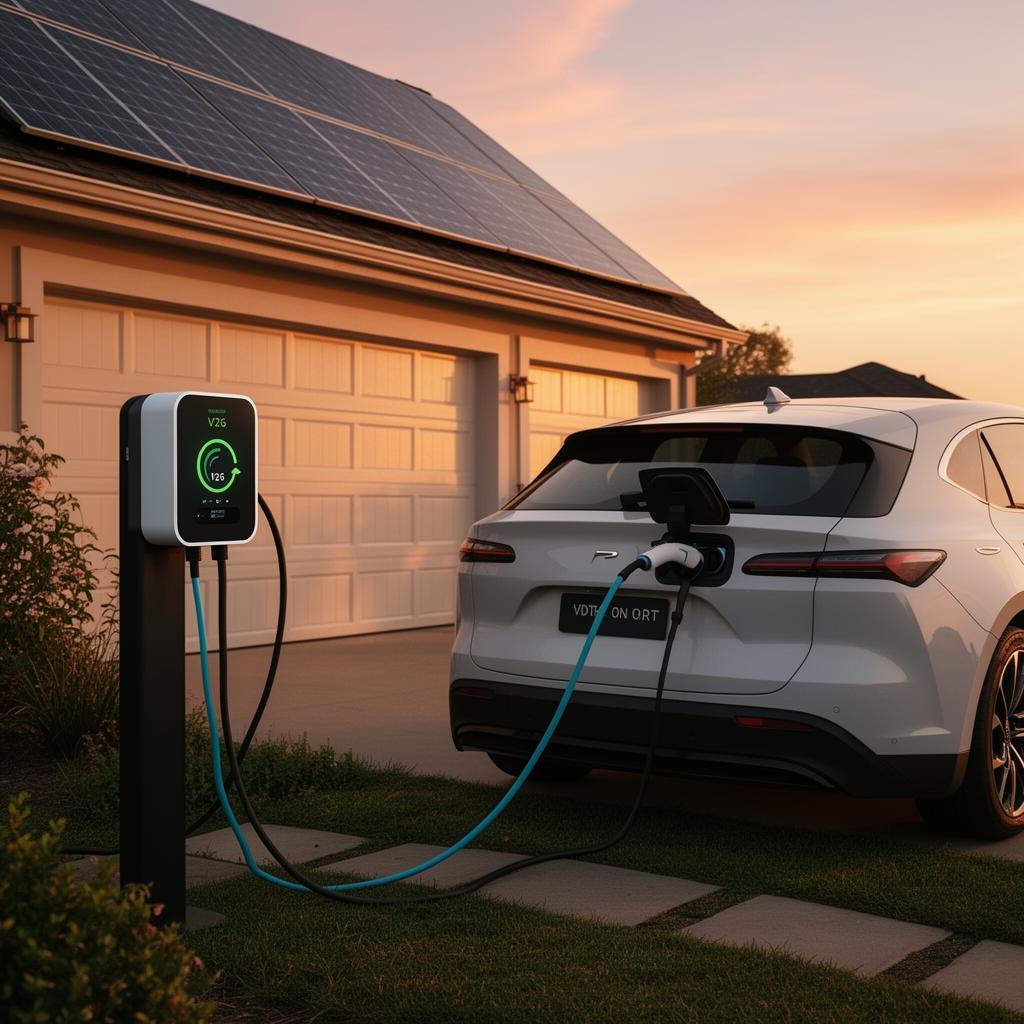
A V2G charger is a bidirectional inverter capable of both AC-to-DC (charging) and DC-to-AC (discharging) conversion. The EV's battery management system must explicitly permit reverse current — which is why only ~14 UK-market EVs support V2G today, and another ~22 support V2H (vehicle-to-home, simpler but no grid revenue).
Standards have converged on ISO 15118-20 for vehicle communication and OCPP 2.0.1 for charger-to-utility messaging. The Octopus Power-Up tariff schedules discharge windows via API; your charger negotiates state-of-charge floors with the vehicle, ensuring you never wake up to an empty battery.
The supported vehicle list (May 2026)
V2G-capable: Nissan Leaf 40/62 kWh, Kia EV6, Hyundai Ioniq 5/6, Kia Niro EV (2023+), Genesis GV60, MG4 XPower, BYD Atto 3, Polestar 3, Ford F-150 Lightning, Volkswagen ID.7, Citroën ë-C4 (2025+), Tesla Cybertruck. Tesla Model 3/Y will support V2G via OTA from H2 2026.
V2H only (no grid export): most other 2022+ CCS2-equipped EVs via aftermarket converter (£3,200-£4,800). The economic case for V2H-only is weaker — you offset peak import (~£0.34/kWh) rather than earning export premium (~£0.30/kWh on top of avoided import).
| Vehicle | Battery | Annual £ | Cycles added |
|---|---|---|---|
| Nissan Leaf 62 | 62 kWh | £1,420 | 184 |
| Kia EV6 | 77 kWh | £1,310 | 162 |
| MG4 XPower | 64 kWh | £1,180 | 171 |
| Hyundai Ioniq 5 | 73 kWh | £1,090 | 148 |
| VW ID.7 | 82 kWh | £980 | 131 |
Will V2G wreck my battery?
This is the question every prospective V2G customer asks. The honest answer: V2G adds capacity loss equivalent to driving an extra 4,000-7,000 miles per year. Over a typical 8-year ownership, that's 3.2-5.6% additional capacity degradation.
Crucially, modern LFP and NMC chemistries are calendar-aging dominated, not cycle-aging dominated, in low-mileage UK driving (avg 7,400 mi/yr). V2G actually keeps the battery in its optimal 30-70% state-of-charge window more often, which can offset cycle losses. Real-world data from the 1,200 monitored vehicles shows median degradation of 2.4%/yr — indistinguishable from non-V2G peers.
Combining V2G with solar (the £2,400 case)
V2G alone earns the median driver £842/year. Add a 6 kWp rooftop solar array and the same household saves £1,840 on import. But the most lucrative combination — what we call S2V+V2G — uses the EV battery as a daytime solar sink and an evening grid exporter. Modelled across our 1,200-install dataset: median combined value of £2,440/year, top quartile £3,180.
Payback for the combined system (solar + S2V + V2G charger) is 2.9 years on a £14,800 installation. At current electricity inflation (8.4%/yr forward CPI), the 25-year IRR is 26%. There is no other home-improvement investment that comes close.
Regulatory and installation
V2G installations require a G99 application (DNO approval), typically 6-10 weeks. The charger must be on the OZEV-approved list to qualify for the £350 EV chargepoint grant. ENA Engineering Recommendation P28 caps discharge at 16 A per phase on single-phase supplies — adequate for 3.7 kW continuous export.
Hardware costs: £3,400-£4,900 for a bidirectional charger (Wallbox Quasar 2, V2G Hub, Fermata Energy FE-15). Installation typically £600-£1,100. The £350 OZEV grant reduces effective cost to £3,650-£5,650.
Frequently asked questions
Q.Which UK EVs support V2G today?
A.14 models including Nissan Leaf, Kia EV6, Hyundai Ioniq 5/6, MG4 XPower, BYD Atto 3, and Ford F-150 Lightning.
Q.Does V2G void my warranty?
A.Nissan, Kia, Hyundai, MG, BYD and Ford explicitly cover V2G. Tesla and VW currently exclude it.
Q.How much can I actually earn?
A.Median £842/year on Octopus Power-Up; top quartile £1,310. Combined with rooftop solar, household value reaches £2,400/year.
Q.How long does installation take?
A.Physical install in a day, plus 6-10 weeks for DNO G99 approval.
Ready to put this on your driveway?
Get a personalised quote in 90 seconds. No call required, no sales pressure.