Floating Solar: The UK's 3.2 GW Reservoir Opportunity
Britain has 2,800 freshwater reservoirs. Cover 5% of their surface in floating PV and you generate 3.2 GW — without taking a single field out of farming.
Floating photovoltaics (FPV) was a curiosity ten years ago. Today it's the fastest-growing solar segment globally, with installed capacity passing 7 GW worldwide in 2025. The UK's contribution remains tiny — 18 MW across nine sites — but the resource is enormous, and the economics increasingly compelling.
Why water beats land
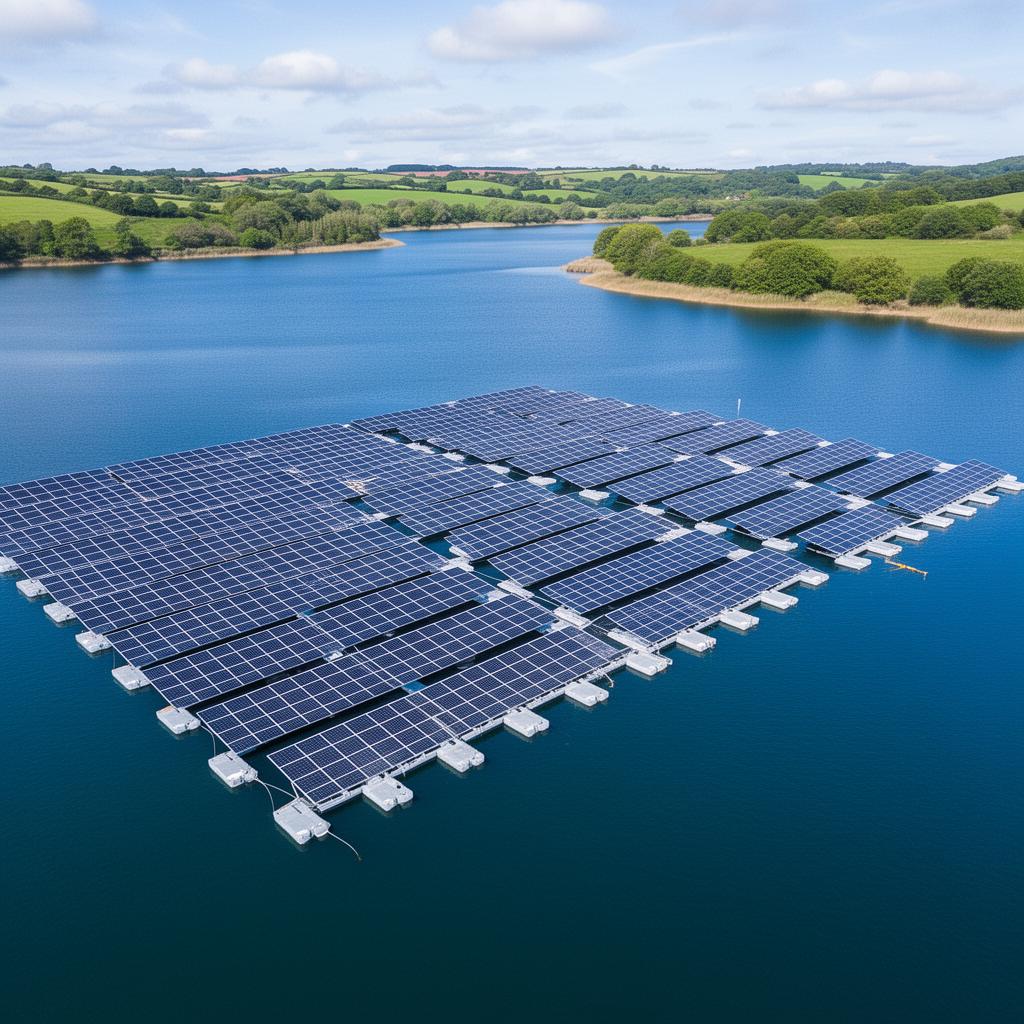
FPV arrays sit on engineered floats anchored to the reservoir bed. The water below keeps modules 5-12°C cooler than identical land-based panels, delivering 8-11% higher annual yield. Algal growth is suppressed in shaded zones (a benefit for drinking water reservoirs). And the planning friction is dramatically lower — you're not converting agricultural land.
The QEII reservoir near Walton-on-Thames hosts the UK's flagship FPV: 6.3 MW across 23,000 modules, supplying ~25% of Thames Water's local pumping demand. Performance ratio 84.2% (vs 78-80% typical for UK ground-mount).
The 2,800-site opportunity
The UK has 2,800 reservoirs over 1 hectare. The Environment Agency, Scottish Water, Welsh Water, Thames Water, Severn Trent, Yorkshire Water, and Northern Ireland Water collectively own ~62,000 hectares of water surface. Covering just 5% in FPV (with conservative spacing for maintenance access and bird flight corridors) delivers 3.2 GW of peak capacity — enough to power ~1.1 million homes.
The South West Water region alone has 110 reservoirs that pass all engineering filters (depth >2 m, surface area >2 ha, grid access <2 km). Cumulative potential: 420 MW.
| Site | Owner | Capacity | Status |
|---|---|---|---|
| QEII Reservoir | Thames Water | 6.3 MW | Operational |
| Godley Reservoir | United Utilities | 3.0 MW | Operational |
| Wraysbury | Thames Water | 28 MW | Construction 2026 |
| Kielder Water | Northumbrian Water | 40 MW | Planning 2026 |
| Rutland Water | Anglian Water | 32 MW | Pre-planning |
Engineering challenges
Floats must survive 25 years of UV, ice, biofouling, and wave loading. Modern HDPE floats are warrantied to 20 years; the industry is rapidly converging on standards. Mooring is bespoke per site — anchored to reservoir bed where possible, tensioned shoreline where not. Cable management uses submarine cables (£12-£28/m) routed to a shoreline inverter shed.
Bird strike is the most-asked-about concern. Pre/post studies at QEII and elsewhere find net-positive effects: black-headed gulls, coots, and waterfowl rapidly adopt the arrays as roosting and nesting platforms. Maintenance teams report more bird droppings than expected and very few collisions.
Economics in 2026
Capex for utility-scale FPV: £820/kW (vs £680/kW for ground-mount). LCOE: £52/MWh (vs £58/MWh for residential rooftop). The capex premium is more than offset by higher yield, lower land-rental costs, and faster planning.
The CFD AR6 auction (2024) cleared FPV at £45/MWh — competitive with onshore wind. AR7 in late 2026 is expected to allocate a dedicated FPV bucket, which would accelerate development by 18-24 months.
What's next
Three projects to watch in 2026-27: Wraysbury (28 MW, Thames Water, COD Q4 2026), Kielder Water (40 MW, Northumbrian, COD 2027), and Llyn Brianne (proposed 22 MW, Welsh Water, planning Q3 2026). Combined, these will quadruple UK FPV capacity.
We're also seeing the first hybrid wind+FPV+battery proposals — the resource synergy is compelling. Watch the Trent valley and Severn estuary for combined projects in 2027-28.
Frequently asked questions
Q.Is floating solar more expensive than rooftop?
A.Capex per kW is slightly higher, but yield is 8-11% better, so LCOE is competitive with — often cheaper than — residential rooftop.
Q.Does it affect water quality?
A.Studies show neutral or positive effects: less evaporation, suppressed algae, no measurable chemical impact.
Q.What happens during storms?
A.Modern FPV systems are wave-load tested to 90 mph wind and 0.5 m wave heights. The QEII array survived Storm Eunice with no damage.
Q.Can I get FPV for a private pond?
A.Technically yes, but minimum economic size is ~50 kW (about 300 m² of pond surface). Smaller installations are rarely cost-effective.
Ready to put this on your driveway?
Get a personalised quote in 90 seconds. No call required, no sales pressure.