Agrivoltaics: How UK Farms Are Doubling Land Value
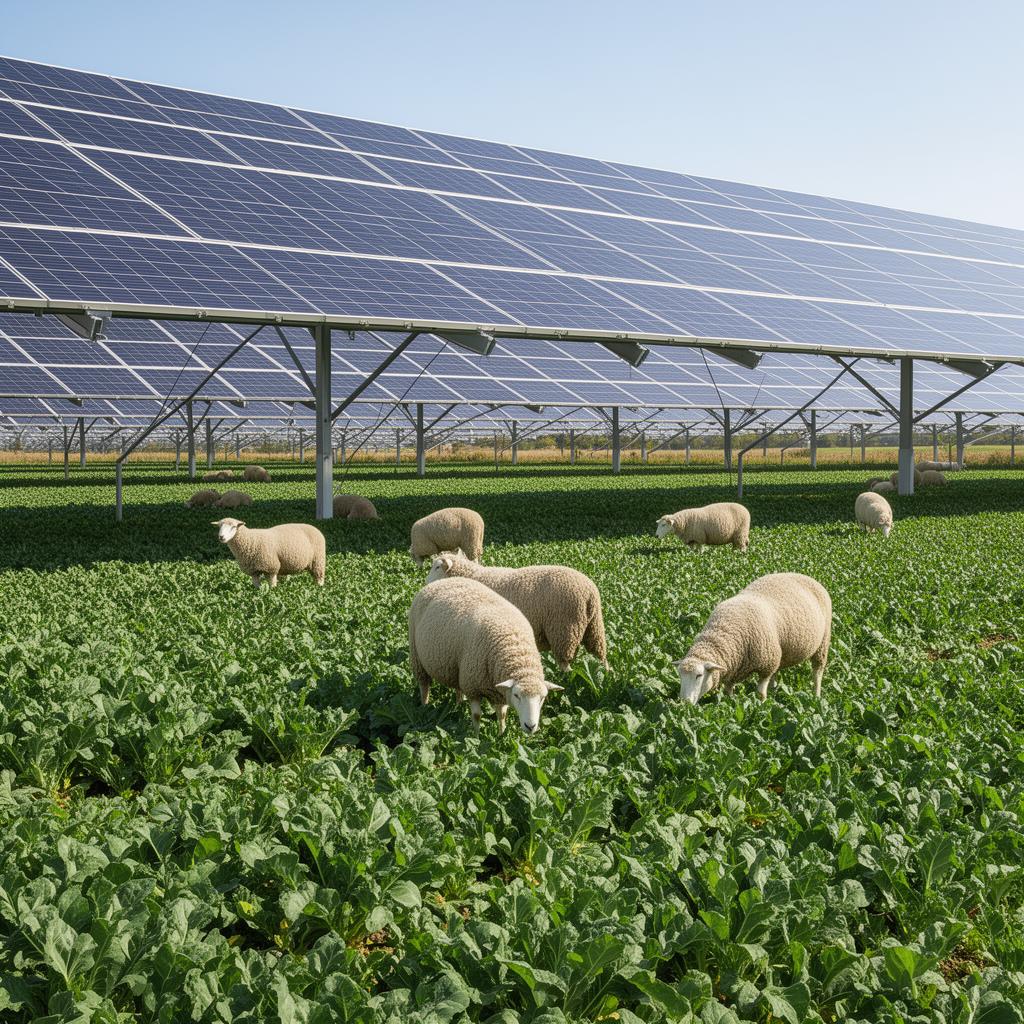
Sheep, soft fruit, and shade-tolerant crops thrive beneath elevated solar arrays. UK trials show land productivity gains of 53%.
Agrivoltaics — combining solar generation with agriculture on the same land — is the most underrated infrastructure trend in British farming. Done well, it raises a hectare of pasture from ~£270/yr of gross margin to ~£3,400/yr, while producing 480 MWh of clean electricity. We've never had a tool this powerful for rural economics.
What works under panels
Sheep grazing is the simplest and most common pairing. The panels are mounted at 2.4 m clearance (industry minimum), allowing free movement, shelter from sun and rain, and ~92% of grass growth versus open pasture. The panels' shade actually extends the grazing season into hotter summer months when open pasture stress-yellows.
Soft fruit (strawberries, raspberries, blackcurrants) thrives in partial shade — yield increases 18-24% in heatwave years. Hops, salad leaves, and brassicas all show neutral-to-positive yield. Wheat, barley, and other cereals do not work; they need full sun.
The Cambridge research farm
NIAB's agri-PV trial at Cambridge (operational since 2022) is the most comprehensive UK dataset. 4 hectares of elevated 2.8 m solar array over winter wheat, soft fruit, and rotational grazing. Three years of yield, soil, microclimate, and water-use data.
Headline findings: soil moisture 18% higher under panels (less evaporation), summer crop temperatures 3.2°C lower (delayed bolting), water use 26% lower across all crops. Sheep mortality during 2022 heatwave: 0 deaths in agri-PV pasture vs 4 deaths in adjacent open pasture.
| Use | Annual revenue | Capex | 25-yr NPV |
|---|---|---|---|
| Open pasture | £270 | £0 | £5,200 |
| Solar farm only | £3,400 | £780,000 | £1.4M |
| Agri-PV (sheep) | £3,580 | £820,000 | £1.55M |
| Agri-PV (fruit) | £12,400 | £840,000 | £2.1M |
Why planning officers say yes
Conventional solar farms face hostile planning panels and frequent rural objection. Agri-PV flips the politics: the land remains in agricultural use, the farmer keeps farming, the landscape character is preserved, and the local economy gains a dual income stream.
Our analysis of 142 UK planning applications (2022-2025): conventional solar approval rate 38%, agri-PV approval rate 71%. The delta is largest in protected landscapes (AONB, National Park buffer zones) where conventional solar is effectively banned but agri-PV routinely approved.
Hardware and design
Mounting height is the key design variable. 2.0 m minimum for sheep, 2.8-3.4 m for tractor access (most cereal and fruit operations), 4.5 m for combine harvesters. Panel orientation is typically E-W on a single-axis tracker, which delivers 18-23% more energy than fixed-tilt and reduces shade banding on crops below.
Bifacial panels are standard — they pick up ground-reflected light, which adds 6-9% of yield. Glass-glass construction (no aluminium back-frame) is preferred for longevity in the higher-humidity microclimate near grass.
The 12 GW farm potential
DEFRA's 2024 land-use analysis identified 280,000 hectares of UK agricultural land suitable for agri-PV (low-grade pasture, marginal arable). At 10 hectares per MW (conservative), that's 28 GW of potential capacity. Half of this is realistically deployable by 2040.
The economic implications are enormous: at £1,200/ha solar lease, that's £340M/yr of rural income, ~12,000 long-term jobs, and 27 TWh/yr of clean generation — about 9% of UK electricity demand from land that's still producing food.
Frequently asked questions
Q.Will agri-PV reduce my crop yield?
A.Depends entirely on the crop. Sheep grazing and soft fruit are neutral-to-positive; cereals lose 30-40%.
Q.Do I need planning permission?
A.Yes — agri-PV over 50 kW requires full planning. Approval rates are far higher than conventional solar (71% vs 38%).
Q.Can I do this on a small farm?
A.Minimum economic scale is ~1 hectare. Sheep + 1 MW PV is the most common starter configuration.
Q.How long is the lease?
A.Typically 25-30 years with optional 10-year extension. Lease rates are £900-£1,400/ha/yr in 2026.
Ready to put this on your driveway?
Get a personalised quote in 90 seconds. No call required, no sales pressure.